
This article was originally published in Arabic on the author’s personal blog in November 2019, under the title “قراءة في قطاع النفط السوداني خلال ثلاثين عاماً: التاريخ، التحديات وآفاق المستقبل.” You can read the original post here. This English version has been translated for Enery International’s Insights section.
Abstract
This paper sheds light on the trajectory of Sudan’s oil sector during the thirty-year rule of the “National Salvation” regime, reviewing the most pivotal milestones the sector passed through in terms of production, global partnerships, and the security challenges that cast a shadow over exploration operations. The paper also analyzes the most significant challenges currently facing the oil sector, including issues of administrative reform, strengthening oversight and transparency, combating corruption, reforming contracts and labor systems, and employing graduates of educational institutions, alongside issues of technological transformation and easing tensions among local communities. The paper also attempts to look ahead at the future prospects of Sudan’s oil sector in light of developments expected to follow the December 2018 revolution, and to assess the initiatives put forward by the forces of the revolution and their outcomes.
Introduction
Discussion of the possible existence of oil reserves in Sudan can be traced back to the early twentieth century. The real beginning of serious exploration attempts was in 1959, when the Italian company AGIP drilled six wells in the Red Sea region. Although that attempt did not succeed in discovering commercial quantities of oil, it did reveal oil and gas indications in some of the wells (1). That attempt was followed by others carried out by foreign companies across wide areas in eastern and northern Sudan. However, one of the major turning points in the history of Sudan’s oil sector was the enactment of the “Petroleum Wealth Act” under former President Jaafar Nimeiry in 1972, which accelerated the pace of exploration and competition among global companies for exploration and prospecting concessions. Among the most prominent of these companies were the well-known Chevron, Total, and Texas Western. Chevron’s intense activity led it to the first actual discovery of Sudanese oil in seven wells in the Mujled and Unity areas, with one well producing eight thousand barrels per day. These discoveries were followed by international reports that Sudan was “sitting atop a lake of oil,” and discussions began about building an oil refinery and laying pipelines.
Sudan subsequently entered a period of security and political turmoil that hindered development in the oil sector, until a military coup brought the “National Salvation” regime to power. The regime’s handling of the oil file followed the pattern typical of coup-installed governments, adopting a “rentier state” model whose economy rests on extracting and selling natural resources. The new regime immediately began taking measures to resume activity in the sector: it divided the country into exploration blocks under a new exploration law, sought loans from potential allies to develop the sector, and escalated pressure on Chevron to either resume its operations or relinquish its concession areas — which Chevron indeed ceded to “Concorp.” A new phase then began, opening the door for foreign companies to invest in the promising sector (1), with Chinese companies securing the largest share of these agreements, establishing production-sharing companies under them and beginning to build the industry’s infrastructure.
The emergence of oil had clear repercussions on the state’s economy. Every sharp turn the sector went through had a pivotal effect on economic performance; oil turned Sudan into an extremely rentier state, with oil exports constituting more than 90% of total exports (1). The rentier state model — dependent on extracting and selling natural resources — was one of the structural flaws that afflicted the Sudanese economy, since rentier states invariably become fragile states in which “oil revenues produce a growth boom without being accompanied by genuine development or political and institutional reform; the state relies for its resources on oil revenues without real production, and its economy becomes wholly dependent on the price of oil, while those revenues are used to buy the loyalty of citizens who are transformed into subjects benefiting from the services provided to them” (2). The former regime stands accused of failing to invest oil revenues in a way that would create sustainable development and a real economy based on vital sectors such as manufacturing and services, as in other advanced countries. There is broad agreement among observers that oil left no tangible mark on improving the lives of ordinary Sudanese, who continued to suffer under worsening poverty, disease, weak equality, and other indicators of poor human development (3). Sudan’s economy is weak and trails behind on most economic indicators, suffering from internal and external shocks such as war, debt, and global crises, as well as poor external relations; it also suffers structurally from its dependence on natural-resource rents, crude exports, government levies, and unproductive internal trade such as brokerage and similar occupations.
Sudan’s oil reserves are estimated at approximately 5 billion barrels (4), of which about 1.5 billion barrels are proven reserves according to specialized reports (5). Sudan’s peak oil production was in 2007, reaching 520,000 barrels per day (6). With South Sudan’s secession and formation of its own independent state in 2011, Sudan lost about 75% of its oil reserves, and production fell to approximately 103,000 barrels per day. The current situation indicates that daily production does not exceed 72,565 barrels according to official statistics (7) for January 2019.
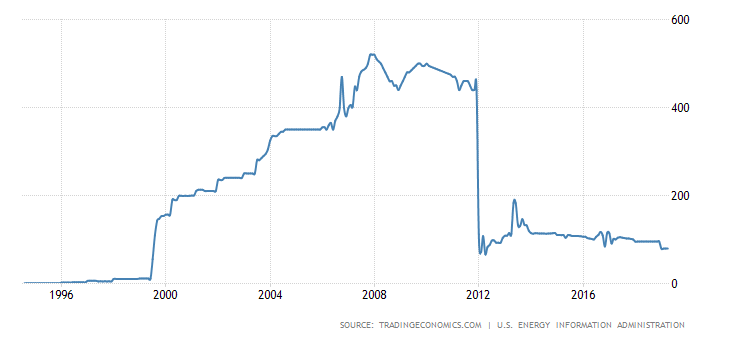
As a rough approximation, if we divide proven reserves by daily production — holding other factors constant — the remaining oil would continue flowing for only about 57 years, taking into account that these calculations involve somewhat imprecise and optimistic assumptions. This necessarily calls for field-development plans, especially since some reports have indicated that, absent new discoveries, Sudanese oil production may have already peaked some time ago.
Given that developing countries are expected to see their energy consumption grow due to rising population growth and an expanding middle class and economy (8), combined with the organic link between development and the accompanying shift toward industrialization and an expanding services sector (9), and the pressing need to create additional energy sources to meet expected rising demand, all future plans must account for the possibility that Sudan may fail to raise the productivity of its existing fields or bring new fields into production, and must therefore find alternatives to secure energy.
Sudan ultimately became a net oil importer in 2014, after oil revenues fell to US$1.25 billion, while the cost of imported petroleum products reached US$1.52 billion (10). Sudan’s economy depends on fossil fuels for 90% of its energy (11), with crude oil accounting for 35% of that (12). Regarding petroleum products, Sudan has a surplus of crude oil, petroleum coke, and gasoline, which it exports (13). Alongside this, there is a shortage of diesel, cooking gas (“butagas”), jet fuel, and furnace oil, which is covered through imports (12). As for infrastructure, Sudan has four oil refineries, three of which are out of service, representing about 20% of total capacity, along with three pipelines and a number of specialized labs and centers.
Historically, energy crises were confined to the oil-supply file, specifically issues of importing and distribution, since Sudan had not yet entered the oil era. Crises in the domestic oil sector increased markedly from the beginning of 2018. In April 2018, a severe crisis occurred involving a shortage of petrol and diesel supplies due to the breakdown of the Khartoum refinery “indefinitely,” as suggested by statements and leaks at the time; as a result, the then-Minister of Petroleum and Gas was dismissed, amid widespread allegations that fuel pumped into the market by the authorities had caused car fires.
In December 2018, a popular revolution erupted in Sudan, succeeding in overthrowing the thirty-year rule of the National Salvation regime. The forces of the revolution began proposing general policies to rebuild institutions, reassess foreign relations, and set out short- and long-term reform and development plans. Building on the above, this paper attempts to provide a brief review of the state of Sudan’s oil sector during the three-decade rule of the National Salvation regime, focusing on certain files. It will also highlight the most pressing challenges surrounding the sector’s development and growth, and will attempt to forecast the future paths the sector may take in the period following Sudan’s December 2018 revolution.
Reviewing the External Role in Developing Sudan’s Oil Sector
Generally, the most prominent contributors to Sudan’s oil sector are the national companies of China, India, and Malaysia, alongside other countries that provided intermittent technical support, such as Norway. As noted in the historical narrative of Sudan’s oil sector above, oil extraction was not an achievement of the National Salvation regime — its foundations had already been laid before that. When the National Salvation coup occurred, three fields were already ready to begin actual production (1). What the regime did was reshape foreign relations in a way that guaranteed it maximum benefit from those oil revenues. The People’s Republic of China was the regime’s preferred partner. China’s relationship with the oil sector dates back to the era of former President Jaafar Nimeiry, who had discussed a file titled “Extraction of Oil and Other Minerals” with the Chinese leadership, along with an exchange of technical and diplomatic missions between the two countries. The relationship cooled somewhat until the era of the National Salvation regime, whose political incubator — the “National Islamic Front” — enjoyed good relations with the Chinese system (1)(14). This good relationship can be understood in the context of China’s general strategy toward Middle Eastern and African states, based fundamentally on the principle of comprehensive economic cooperation and shared development, and China’s historical foreign-policy commitment to non-interference in what it describes as the internal affairs of other states (15) — in line with the absolute pragmatism it favors, and also to avoid stirring up issues of domestic politics, minority affairs, autonomous regions, and other matters that could threaten the ruling party’s tight internal grip.
In light of these considerations, the National Salvation regime turned toward China for several reasons, among them: the regime’s urgent need for a quick-return cash and economic resource to enable it to run the machinery of the nascent state; the regime’s international isolation — whose early signs had already appeared — due to its having carried out a military coup, its ties to global terrorism, and its threats to neighboring states’ security; and China’s economy, which was witnessing very rapid growth and a thirst for energy to meet the needs of its industrial sector, which pushed the Asian country’s leadership to direct its companies toward the necessity of owning oil reserves beyond its borders (1). Accordingly, China took upon itself the task of entering into a partnership to help Sudan develop an oil industry. China’s grip on the sector was tight, to the extent that Chinese companies controlled field services, well drilling and maintenance, field construction, pipeline laying, and the building of loading ports. In addition, Chinese companies obtained other privileges, such as participating in closed tenders — restricted to them alone — for selling Sudanese oil (16).
Despite the outwardly good relationship between the two partners, it has cooled somewhat in recent years. Numerous reports speak of foreign companies’ discontent with the state’s oil policy and their considerable reluctance to proceed further with investment in Sudan’s oil sector. The Sudanese side’s poor financial performance and its shortfalls in meeting financial obligations and accumulated debts owed to Chinese companies — which reached at least two billion dollars by the lowest estimate (17) — are among the most prominent points of contention frequently debated.
Alongside the distinctive relationship with China stood another relationship marked by coldness and estrangement with European states and the United States. Among the most prominent milestones of that relationship was the imposition of a broad package of economic sanctions and embargoes intended to prevent the regime from consolidating its grip on the machinery of the state and securing its survival. In 1992, the United States enacted a strict sanctions regime against Sudan, tightened again in 2006 with three new provisions, one of which barred U.S. citizens and companies from any kind of dealings with Sudan in the fields of oil, gas, and petrochemicals. As stated in Executive Order 13412, issued by former U.S. President George W. Bush: “…notwithstanding any contract entered into or any license or permit granted prior to the effective date of this order, all transactions by United States persons relating to the petroleum or petrochemical industries in Sudan, including but not limited to oilfield services and oil or gas pipelines, are prohibited” (18). The United States began in 2006 issuing a series of licenses and exemptions from the sanctions imposed on Sudan; in 2011 it permitted American companies to participate in the transport of South Sudan’s oil. The sanctions specific to the oil sector were fully lifted in October 2017, and although nearly two years have passed since that pivotal decision, American companies’ participation in Sudan’s oil sector remains virtually nonexistent.
The Petro-State and the Rise of Security Challenges in Oilfield Areas
The close link between the emergence of oil resources and the security challenges that follow is a widely recognized phenomenon; the history of Sudan’s oil sector is closely tied to a history of conflict, violence, and insecurity (9). If we adopt the view that development is inseparable from answering questions of social justice and equality, then violence stemming from weak justice threatens not only human security but development programs as well (19) — especially since natural resources are the backbone of development in rentier states. The state of insecurity and armed conflict in developing countries is nothing but an expression of fragility in the structure of the state and society, and of inequality.
Historically, early signs of oil discovery’s impact on the security landscape appeared in 1983 in the dispute between the central government and the then-Sudan People’s Liberation Movement, when the opposition movement — representing groups in the south — expressed its discontent at the central government’s intention to concentrate infrastructure-building for the promising industry in the northern regions (present-day Sudan), despite the majority of producing wells being located in the southern regions, particularly in what is now South Sudan, already burdened by years of conflict with the center. The government’s insistence on relocating a refinery site that Chevron had agreed to build to the north instead of the south, and rerouting the oil pipeline to pass through Port Sudan instead of the Kenyan port of Mombasa, were among the most prominent grievances raised by southerners (1). The spark for the outbreak of violence was an attack by the southern opposition on a Chevron facility that left several dead and led the company to freeze all its activities in the country by 1985.
After the National Salvation regime came to power, confrontation with armed groups was escalated, with the regime launching a military campaign known as “Summer of Crossing” against areas controlled by the Sudan People’s Liberation Army. The regime also began forming groups of local residents to secure oilfield areas; some of these groups were defectors from the People’s Liberation Army and some southern tribes of African origin, while others belonged to Arab tribes such as the nomadic Misseriya groups (9).
The security conflict in oil-rich areas was first ignited by politically oriented movements such as the Sudan People’s Liberation Movement, but it soon drew in groups from local tribes and populations. Taking the Misseriya tribes as a sample of local groups expressing grievance over the mismanagement of the oil file, they have long voiced dissatisfaction with the negative impact of exploration operations on their way of life and the marginal benefits they receive in terms of job opportunities and development projects. Environmental disasters such as deforestation, water pollution, livestock deaths, and reduced rainfall and crop and livestock productivity were among the most prominent grievances raised, reflecting the sense of injustice felt by local populations toward central authorities, which led some groups among them to carry out repeated attacks on oil operation sites (9). Worth noting also is another file related to the security situation in field areas — that of the oil-rich Abyei region (home to the Diffra field in the north), located on the border between Sudan and South Sudan. The region remains disputed between the two sides, still awaiting judicial resolution.
Key Issues and Challenges Facing Sudan’s Domestic Oil Sector
First: Institutional Reform, Restructuring, and Sound Management
The short-term outlook adopted by the former National Salvation regime — rushing to produce oil in order to obtain cash quickly — led to deep-rooted problems in the oil sector. The general problems that afflicted the structure of the state and its institutions also extended to the oil sector, and often more acutely, given the particular vulnerability of such a sector within the state’s very fragile institutional fabric. The management of a vital sector like the oil sector was never up to the required standard, and as a result, corruption spread, transparency was absent, centralization prevailed (2), and interest groups multiplied.
One manifestation of the sector’s dysfunction relates to the lack of transparency, which has been shrouded in secrecy and concealment since its inception. The organization Global Witness, in one of its specialized reports, cited the World Bank as saying that transparency in Sudan’s oil sector was “unusually weak” compared to other developing oil-exporting countries (16) — notably, since sectors in such countries are typically not transparent either, this description makes Sudan’s oil sector “the worst of the worst”! The same report indicated that the Ministry “does not produce detailed statistics or reports on the sector or on project developments, that the state oil company does not disclose public accounts, and that there is very little information available on the business developments of companies operating in Sudan.” Among the manifestations of the lack of transparency identified by that report: the production quantities announced by the Sudanese government were lower — by up to 26% in some blocks — than those published by the China National Petroleum Corporation; Sudanese citizens (nor, previously, the government of the south) have no way of verifying the accuracy of the oil revenues received by the government; there is no disclosure of the details of provisions and key variables in oil agreements, preventing adequate scrutiny of accounts; the tender-award process is shrouded in some ambiguity, having on more than one occasion involved closed tenders restricted to Chinese companies only; and some influential figures in government bodies responsible for regulation and oversight simultaneously hold commercial interests in some of these companies (16). In the same vein, nothing is known about the budgets of the institutions entrusted with managing the sector — neither the “Sudan National Petroleum Corporation” (before its dissolution) nor the national company Sudapet had their budgets approved through either the National Council (parliament) or the Ministry of Finance and National Economy, and the Auditor General’s reports concerning the latter are not published publicly (9).
Mismanagement also manifested in the weak institutional framework governing the sector, with numerous complaints of interference by local actors in oil areas and political figures from the National Congress Party, as well as circles close to the former president, seeking to influence oil policymaking. “Internal interest groups” linked to the ruling elite and the regime’s security arms — such as the National Intelligence and Security Service, with its wide-ranging influence in the sector — are alleged to hold shares in contracted Sudanese investment companies such as Hi-Tech Group, Bashaer, Petronet, Heglig, Qadera, Nabta, and Qasr Al-Lulu (9)(20).
The nature of the structures and entities entrusted with managing the oil sector, and the relationships among them, remain a subject of wide debate. There are three main actors in the sector’s governance: the Ministry of Petroleum and Gas is the highest authority responsible for managing the sector comprehensively and represents the state in the optimal exploitation of hydrocarbon resources. From the 1990s until March 2019, an entity affiliated with the Ministry called the “Sudan National Petroleum Corporation” — a government authority overseeing all oil exploration and production operations, the conclusion of contracts and agreements, holding shares in companies, and regulating and overseeing the distribution of petroleum products, among other things (21) — operated under it. There is also Sudapet, which represents the state in participating in operating consortiums as a representative of the Sudanese government. There are numerous claims of murkiness in the work of these bodies and occasional conflicts between their mandates. The last prime minister under the National Salvation regime took reform steps in state structures, most notably the decision to dissolve the Corporation and transfer all its assets and holdings to the Ministry of Petroleum and Gas — a move that stirred wide controversy (22).
On this point, in the file of oil policy, two different schools of thought emerge regarding who should sit atop the sector’s management hierarchy. One view holds that the operating companies — established under production-sharing agreements between states — possess extensive technical expertise in managing and developing fields, and that they were founded and are run on the basis of merit and competence in hiring and assigning tasks, rather than on personal relationships and favoritism as in government institutions — which has given them highly qualified staff, and therefore management responsibility should be entrusted to them. On the other hand, the opposing view argues that despite these companies’ high technical capabilities, it is not appropriate to entrust them with managing this sensitive file, and that such companies should instead operate under the authority of institutions structured like government facilities (23). The same applies to Sudan: the author of this paper, during a business visit in early 2019 to the headquarters of one of the operating companies, had a conversation with one of its managers that branched into the topic of sector management; the manager stated that those from within the regime who sit atop the sector’s leadership are among the greatest obstacles to development, since many of them rose through political backgrounds without possessing the technical qualifications needed to make science-based decisions.
Second: Easing Tribal Tensions in Areas Adjacent to Oilfields
Sudan’s producing oil fields are located in Darfur, Abyei, the Nuba Mountains, and formerly the south — regions of war, tribal conflict, and disputes spanning decades. The issue of security and peace in local communities has received intense attention over the past three decades, whether at official levels or through writing and discussion among those concerned. The roots of these conflicts in the western and “new south” regions go back to disputes over pasture and land; Sudan’s political crisis gave these conflicts another dimension, represented by the emergence of local groups and armed movements fighting the central government, accusing it of racism and marginalization. According to the government, attacks on fields have evolved to include the commission of crimes threatening security and affecting oil-extraction operations; since the early 2000s, attacks by local populations against field workers and company assets have escalated, including numerous incidents of killing, kidnapping, looting, and destruction of property (1)(9).
The sense of grievance, marginalization, and encroachment on their historical environment has not been resolved by the policies of the central government and its foreign-company allies. Some of these government policies included allocating a fixed rate of at least 2% to the state government from which the oil is extracted (9), as stipulated by the earlier Comprehensive Peace Agreement, and the contribution of foreign companies to building infrastructure and supporting some local development projects through what is termed “social responsibility” spending — allocating funds and support from companies to help local communities and involve them in benefiting from the wealth of their land. However, representatives of local communities typically view such assistance as a paltry price paid in exchange for their silence about the exploitation of resources and the damage inflicted on natural environments — as noted earlier — in addition to being insufficient to redress the harm done.
In any case, it appears that tribal tension in these areas will continue to cast its shadow unless policies are enacted to resolve the problem, whether narrowly — as harm inflicted on local populations — or broadly, within a discourse arguing that the roots of the Sudanese state’s crisis lie in a conflict between margin and center over marginalization and the monopolization of power and wealth (24). The sense of marginalization and inequality is among the greatest threats to stability and development, not only for local communities but for the state as a whole.
Third: The Technological Challenge
The issue of the technological challenge in the oil sector can be addressed on two levels: first, technical problems within the domestic oil sector, and second, issues of “technological transformation” and “technology localization.” To begin, technical and engineering problems are among the most prominent challenges facing field operators and service companies — problems such as the inability to make use of associated gas volumes, reducing and properly treating and disposing of produced water, reducing sand production, increasing recovery rates from reservoirs, developing unconventional reserve fields, and others. The roots of some of these problems trace back to poor decisions by decision-makers driven by haste and short-sightedness; for example, some specialists attribute the very high rates of water and sand production to production rates that were too high and unsuited to the nature of Sudan’s oil reservoirs — the rush to produce oil, driven by the need for quick cash (as noted earlier), may have been motivated by anticipation of future events such as the secession of the south’s oil-bearing regions. Interestingly, one South Sudanese army commander commented on the regime’s pumping of oil in massive quantities before the south’s secession, saying: “The oil situation in Sudan is like lending someone your cow full of milk, only to get it back and be surprised that all its milk has been consumed” (16).
On the front of technological transformation, the technology provided by companies in the sector was never the most advanced by any measure — most of that technology was of Chinese origin, given China’s dominance of the largest share of well-drilling and maintenance service concessions in the fields. One of the justifications the National Salvation regime offered in the 1990s for turning to China as a partner in developing the sector was that it “needed uncomplicated technology, and this is available in China” (1); thus the decisive factor in choosing technology was not its quality or suitability for local fields, but rather ease and simplicity, so that oil could be extracted and sold as quickly as possible. Ironically, when that partnership request was first made to China, it initially apologized for leading efforts to build Sudan’s oil industry, stating that its companies did not possess the appropriate technology for that task (1). Several pieces of evidence support the credibility of that Chinese apology: the Khartoum refinery was the first refinery Chinese companies ever built abroad, and Chinese news agencies covered the news of winning the contract to extend Sudan’s first oil pipeline with considerable enthusiasm.
Technological challenges are met through numerous approaches and mechanisms aimed at achieving genuine technological transformation in the state and society. Moving from a state of failure to properly engage with the technology file to a state in which the country is capable of meeting the needs of its various sectors is among the greatest challenges facing developing countries in their pursuit of becoming industrial societies. The issue is usually approached from a holistic perspective encompassing the state’s sectors as a whole, not confined to a single sector in isolation from the rest, because devising solutions requires taking into account matters of policy, economics, law, and governance and development pathways, since it is “a complete system, not merely simple scientific and technological breakthroughs emerging from a limited group of members” (25). Fragile states — like Sudan, for example — that fall victim to the “brokers” of industrial nations suffer from multiple underlying problems, among them “the absence of reliable infrastructure to encourage and market local technologies and innovations, failure to build local technical skills, the import of technologies unsuited to local contexts, and the absence of clear plans specifically concerned with technological development, as opposed to development plans in general terms — in other words, a lack of political and institutional rationality” (26). During a hearing of the U.S. Congress’s Energy and Commerce Committee on the nature of the technological shift that occurred in America’s energy sector — making it the world’s largest oil producer — and on how that happened so quickly, and whether similar competition or attempts at comparable technological breakthroughs were possible, the well-known energy expert Dr. Daniel Yergin responded that this was unlikely in the near term, since the shift that occurred in the American energy sector resulted from several interlocking factors: the availability of natural resources, a vibrant economic climate, appropriate legislation, and a widespread culture of entrepreneurship. These and other factors form an interconnected supply chain that currently enables America to continuously access and effectively apply advanced technology in order to maintain its leadership (27).
The issue of technological transformation is among the thorniest issues in development, requiring serious plans and studies to arrive at models and approaches suited to lifting a given state out of technological dependency toward broader horizons. Although there are scattered indications that the issue is receiving attention from decision-makers in the sector, attempts to address it (28) are not sufficient to fix the dysfunction, and the issue remains fertile ground for those concerned to offer their contributions toward a solution.
Fourth: Reducing Unemployment Among Petroleum Engineering Graduates and Improving Working Conditions for Oil Company Employees
The issue of unemployment and weak job placement among graduates of petroleum engineering departments is not a peripheral issue, since human capital is the foundation on which the development process rests, and indeed the very thing that development ultimately seeks to bring comfort to. The issue of petroleum education, training, and building local capacity has drawn the attention of all actors in the sector; for example, the mission statement of the Sudan National Petroleum Corporation was framed to include “building national capacities and qualifying them to reach world-class expertise levels” (21), and training Sudanese cadres and enhancing their capabilities was also among the provisions of agreements signed between the Sudanese government and foreign companies.
There are several departments teaching petroleum-engineering specializations across three universities: Sudan University of Science and Technology, University of Khartoum, and Al-Salam University. Enrollment numbers in these departments are usually a matter of controversy, often described as “unreasonable” relative to labor-market needs. Taking a sample for analysis: the petroleum engineering department at the College of Petroleum Engineering and Technology at Sudan University stated that, by the end of 2016, it had graduated more than 1,000 students (29), taking into account that there are two other departments in the college, in addition to students in the college of technology and technological bachelor’s programs who also study petroleum-engineering-related programs. Another sample is Al-Salam University, which began admitting students to its “Water and Environmental Engineering” college in the very same year the country lost three-quarters of its oil reserves! The number of students currently enrolled there has reached about 900, across three departments as well (30). The issue of weak employment, training, and scarce opportunities is acknowledged by relevant bodies such as the Ministry, universities, and companies, and has been raised on a number of occasions (31); although no official unemployment statistics have been issued to date, some statistics announced by graduates themselves indicate that the rate of unemployment and working outside one’s field among graduates of the College of Petroleum Engineering and Technology at Sudan University exceeded 90% over the past five years (32).
In diagnosing the high unemployment rate among petroleum-engineering graduates, several reasons are offered, largely mirroring those faced by graduates of technical and vocational education in Sudan generally (33), with the roots of these problems tracing back to accumulated political, economic, and organizational failures that have not received sufficient seriousness to resolve them. Among the political reasons: the absence of a clear strategy for petroleum education linked to the state’s development plans, and the lack of close ties between government institutions, petroleum-engineering departments, and the entities that would benefit from graduates. Among the organizational reasons cited: the haphazard expansion in establishing departments without sound planning tied to labor-market needs, neglect of continuous training and development for teaching staff, and a lack of accurate statistics and data relied upon in drawing up educational strategies and policies. Among the financial obstacles: insufficient budget allocation for educational institutions in terms of training and student development, alongside establishing and maintaining infrastructure that keeps pace with scientific and technological progress.
The issue of poor conditions for professionals and workers has not been absent from public discussion and reform attempts in the country, given the recurrence of strikes and protest sit-ins by field workers (34)(35) demanding improved working conditions and contracts. The “Sudanese Professionals Association” — the most prominent component among the forces of the December 2018 revolution — stated upon its founding that one of its core missions was to work toward securing fair and adequate wages; the Association’s statistics showed that the Sudanese professional, employee, and worker held the second-lowest wage in the world, earning less than nine dollars a month, and that all Sudanese professionals, workers, and employees earn wages below the poverty line (36). The negative effects of low wages and poor working conditions extend to reduced job performance, low satisfaction indicators, and weak stability, which previously prompted the Association to call for wage adjustment and increases. In the same vein, there have been repeated complaints from teaching staff in petroleum-engineering departments, the most prominent of which concern the general mismanagement of the oil file, weak scientific research and training capacity, lack of transparency, and the localization of the industry, among others (31).
Future Trajectories for Sudan’s Oil Sector in the Post-December 2018 Revolution Period
Broadly speaking, no plan for developing the oil sector will succeed unless the appropriate context exists — namely, a state with at least a minimum degree of political stability, transparency, and justice. In the near term, the opportunity to fix the sector’s dysfunction and pull it out of its bottleneck lies in avoiding the very same approaches by which the sector was managed over the past three decades. This paper will attempt — briefly — to forecast the possible prospects for the future of Sudan’s oil sector, and to review some of the plans that have been proposed for the transitional period.
- Toward institutional and administrative reform, the forces of the revolution proposed a package of medium-term reform policies, some of which touch the energy sector generally and oil and gas specifically. For example, regarding restructuring, combating corruption, and increasing transparency, there is a need to “establish a mechanism to clarify petroleum revenues and ensure they go to the state budget to be spent on the country’s development priorities” (37) — a self-evidently sound decision, since weak transparency in the oil sector will continue to significantly deprive it of forms of cooperation and support, given the growing global trend of linking the receipt of such support to progress on governance and transparency files. Some argue that mismanagement and short-sightedness are not confined to the oil and gas sector alone but extend to the entire energy sector. What policy has the state pursued on the energy file? A question frequently asked, with no satisfying answer! The “University of Khartoum Professors’ Initiative” — a coalition of professors from the prestigious university — answered the question by stating: “There are no clear energy policies… there is randomness and a patchwork structure of accommodations (to provide for multiple ministries) that does not link the different sources and sectors of energy (electrical, hydro, and thermal power, and the Ministry of Petroleum and Gas, and the Ministry of Agriculture and Forestry). Nor is there any coordinating body linking all these entities, which leads to a lack of clarity of vision and negative overlap among the various ministries and departments” (38). The initiative also proposed a number of policies and programs, including establishing a high-level coordinating body for energy and mining, identifying the country’s energy sources and needs and ways to rationalize and improve efficiency of use, creating an investment-friendly climate, localizing energy industries, setting strategies and mobilizing national expertise in the field, strengthening cooperation between educational institutions and research centers, developing management and governance methods in the sector, and converting the government and security-linked companies operating in the sector into public shareholding companies.
- Forecasting the future of Sudan’s oil production cannot be done with complete certainty. On one hand, if we review the pattern production has followed throughout its history, along with its continuous decline, and add to that other factors such as the loss of three-quarters of reserves with the south’s secession, weak performance in exploration and production — since most enhanced-oil-recovery efforts and new exploration have not succeeded (9) — foreign capital’s reluctance to invest in the country, and the likely continuation of military and security-institution companies’ influence in the sector, we can paint a grim picture of a future in which production will not continue for long before halting, and may not even reach the 57 years previously assumed. Nevertheless, there remains a glimmer of hope for raising the production ceiling if both administrative and technical plans succeed in addressing the sources of dysfunction.
- On the partnership file, and regarding future directions for Sudanese-Chinese cooperation in the sector, both Shell (the British company) and the International Energy Agency have estimated China’s energy needs — specifically, the quantities the Chinese dragon will import — at approximately 8 million barrels per day (1). China has also entered the renewable-energy market strongly, having been the world’s first investor in the field, with total investments exceeding US$102 billion. On the other hand, Sudan has already passed its peak oil production and its output has continued to decline for years, with most of that production consumed domestically. Combining these factors, and taking into account that Chinese companies avoid venturing into areas without promising reserves (39), Sudan may no longer hold the same importance for China, which could expose bilateral relations to cooling. In the same vein, regarding relations with neighboring states, the energy file has had a strong presence in shaping foreign policy: Sudan serves as the mainstay South Sudan depends on for processing its oil and transporting it to export ports, and since 2014 Sudan has become an importer of electricity from Ethiopia in exchange for supplying it with some petroleum products. Post-revolution developments can be predicted to mean the energy file will play a larger role in relations with neighboring states, alongside the challenge of convincing foreign investors to support activities to raise production and enter new exploration operations, despite the frustration that has accompanied them from their experience with the former regime.
- On the security-tension file, decision-makers must recognize that the sense of marginalization and inequality is among the greatest threats to stability and development — not only for local communities in field areas but for the state as a whole — since it fuels extremism and undermines the foundations of comprehensive and sustainable development for all, and its worsening could damage social cohesion and the quality of institutions and policies (9). The former regime’s policy — a carrot-and-stick approach involving security-based dealings with citizens, combined with allocating shares of oil rent to local leaders and chiefs — will not address the roots of the problem. New approaches must be adopted that fundamentally embrace the development of these regions and their people, requiring development plans that increase employment and improve working conditions, expand educational and welfare opportunities, and establish small enterprises. Some of these plans and programs cannot be implemented by the oil sector alone, but at minimum they must be taken into account and pushed toward implementation. “Forces of Freedom and Change” — the largest coalition of Sudan’s revolutionary forces — addressed the matter of ending conflicts by tackling the roots of the crisis and working to resolve them; in a document titled “Proposed Outline of an Emergency Program for Sudan During the Transitional Period,” it stated that among the transitional authority’s tasks are ending conflicts, restoring the rights of those wronged, and providing reasonable compensation for those harmed by the former regime’s policies. Some of these plans include redistributing power and wealth and urgent development demands and land-reform programs (37).
- On the front of unemployment and weak graduate employment, indicators point to the problem persisting and potentially worsening in the future. In devising solutions to the problem, the relevant bodies (the Ministry, universities, companies) argue that they are continually working to find suitable solutions; the response from graduates centers on questioning the sincerity of these efforts from some of these bodies, and on the effectiveness of measures taken by others. Improving the conditions of petroleum-education graduates — an education system now a quarter-century old — can begin with a study of the current state of the oil-and-gas labor market and its real needs, after which solution models can be proposed aiming to align college output with labor-market needs, in a way that redresses the harm done to graduates. On the working-conditions front, plans have also been proposed to reform wages, raise them above the poverty line, and establish firm labor laws (37).
- Technical and engineering dilemmas will persist unless steps are taken to compel those responsible to adopt methodologies grounded in scientific research and rigor, which requires strengthening cooperation between educational institutions and research centers and developing management and governance methods in the sector, as previously proposed (38). The technological challenge and technology localization may not be addressable in the foreseeable future, particularly since it requires other supporting factors such as developing infrastructure, services, and the local economy — technology is never separate from the entity in which it operates, whether the state with its institutions or society, and the context — with its economic, social, and cultural factors — determines whether technological innovation occurs, and the nature and scale of the major transformations required to achieve such breakthroughs (40).
Conclusions
Thinking about establishing an oil industry in Sudan began early in the last century, and successive efforts succeeded in actual oil exploration in numerous areas, with one well’s production reaching eight thousand barrels per day. This was followed by actual planning to develop the oil industry with all its components, but turmoil in the security situation forced work on those plans to be halted and frozen. In the late 1980s, a military coup brought the “National Salvation” regime to power, and the new regime adopted a “rentier state” model, its economy based on extracting and selling natural resources to ensure its continued rule and secure quick sources of cash. The regime began resuming exploration and production activities, including administrative measures, securing financing, and seeking foreign partners, among other things. Sudan possesses about 5 billion barrels of oil wealth, of which nearly 1.5 billion barrels are proven reserves, despite having passed peak production and lost three-quarters of its reserves with South Sudan’s secession and formation of its independent state.
Adopting the rentier-state model had a negative impact on the Sudanese economy, as oil revenues were never invested in achieving a developmental leap across the state’s sectors, nor in institutional and political reforms. Oil rent failed to lift Sudanese people out of the grip of poverty, disease, inequality, and other indicators of weak human development. In light of China’s general strategy toward Middle Eastern and African states — based on economic cooperation and shared development, non-interference in other states’ internal affairs, and a commitment to pragmatism — alongside other factors, a partnership emerged between the National Salvation regime and China in the oil sector, enabling China to secure tight control over the sector’s key levers.
The general condition of the state under the National Salvation regime had a clear and direct impact on the performance of various sectors, including the oil sector. The sector suffered from several problems, including a lack of transparency, the spread of corruption among internal interest groups and security arms, and ongoing security tensions in oilfield areas rooted in the sense of grievance felt by local communities. The sector also suffers from weak technology in use, alongside the injustices faced by workers in terms of poor working conditions and contracts, and the alarming rise in unemployment among petroleum-engineering graduates.
Numerous programs were proposed by the forces of the December 2018 revolution for the purpose of reform and problem-solving; these proposed development programs require an appropriate context involving a minimum degree of political stability, transparency, justice, and sound governance. The state must legislate policies and set out future plans, so that even if a crisis erupts, it will only require “trimming” those policies, rather than the chaos that has surrounded the sector over the past period. In any case, this paper aimed to touch upon the headlines of numerous topics, as a contribution toward formulating a general framework through which the state of the oil sector, its challenges, and its future outcomes can be understood — a contribution, because grasping a file of this scope in full is a difficult task, and an attempt at understanding, since the sector’s historical development and current nature present obstacles that preclude asserting any definitive research conclusions.
References
- Ahmed, Jaafar Karrar. “The Story of Sudanese Petroleum: Sino-Sudanese Cooperation in the Oil Sector — Origins, Development, Opportunities and Challenges,” analytical study. [in Arabic]
- Abdelsalam, Aya Badr Alaywa. May 2017. The Failure of the Rentier State Model: A Reading of the Venezuelan Crisis. Arab Center for Research and Policy Studies. [in Arabic] https://bit.ly/2Z8cCMX
- Human Development Indices and Indicators: 2018 Statistical Update, “Briefing note for countries on the 2018 Statistical Update – Sudan,” United Nations Development Programme, accessed 24/08/2019, at: hdr.undp.org/en/countries/profiles/SDN
- Mansour, Abdelmajed A. “Innovation and Technology Transfer in Exploration & Production Industry in Sudan.” 17th Africa OILGASMINE, Khartoum, 23–26 November 2015.
- BP. 2018. BP Statistical Review of World Energy 2018. June 2018. UK: Pureprint Group Limited (67th edition).
- “Sudan Crude Oil Production,” Trading Economics, accessed 26/08/2019, at: http://bit.ly/343Nki3
- “Crude Production Report for January 2019,” Republic of Sudan – Ministry of Petroleum, Gas and Minerals, accessed 24/08/2019, at: http://bit.ly/2KWjBQA [in Arabic]
- Ali Abdelraheem Abumoreim, “Sudan: Hazy Horizons (1–3),” Sudaress, published 11/06/2014, accessed 24/08/2018, at: http://bit.ly/2zhbTtu [in Arabic]
- James, Lauram. “Fields of Control: Oil and (In)security in Sudan and South Sudan,” Small Arms Survey – Human Security Baseline Assessment project, published December 2016, accessed 02/05/2019, at: http://bit.ly/324irYN
- “Member States: Sudan,” Regional Center for Renewable Energy and Energy Efficiency, accessed 24/08/2019, at: http://bit.ly/2zgfatb [in Arabic]
- Rabah, Ali A., Nimer, Hassan B., Doud, Kamal R., and Ahmed, Quosay A. “Modelling of Sudan’s Energy Supply, Transformation, and Demand,” Journal of Energy, Volume 2016, Article ID 5082678, http://dx.doi.org/10.1155/2016/5082678
- Ministry of Finance and Economic Planning, “Economic Survey 2017,” 2017, p. 96. [in Arabic]
- “Guns, Oil and Darfur: The Evolution of Relations Between China and Sudan,” Sudan Report: Human Security Baseline Assessment, Small Arms Survey, published 7 July 2007, accessed 24/08/2019, at: http://bit.ly/2ZqmdtV
- Al-Abdulrahman, Hikmat. “China’s Middle East Strategy: From the Great Wall of China to Economic Openness,” Arab Policy Journal, Arab Center for Research and Policy Studies. [in Arabic]
- Global Witness, “Fueling Mistrust: The Need for Transparency in Sudan’s Oil Industry,” 09/2009, at: http://bit.ly/2KYii3g
- Asim Ismail, “Sudan Seeks New Debt Rescheduling with China,” Al Araby Al Jadeed, published 29/08/2018, accessed 26/08/2019, at: http://bit.ly/2zqrB5q [in Arabic]
- Federal Register, “Executive Order 13412 — Blocking Property and Prohibiting Transactions with the Government of Sudan,” Federal Register / Vol. 71, No. 200 / Tuesday, October 17, 2006 / Presidential Documents.
- United Nations Development Programme, “Human Development Indices and Indicators: 2018 Statistical Update,” 2018, p. iii.
- Kamal Abdelraheem Karrar, “Petroleum in Sudan: Reality and Future Prospects,” Sudanese Economist website, accessed 24/08/2019, at: http://bit.ly/2NuRfyo [in Arabic]
- “Introductory Profile of the Sudan National Petroleum Corporation,” Sudan National Petroleum Corporation, accessed 24/08/2019, at: https://bit.ly/30xlBEa [in Arabic]
- Mohammed Abdelraheem, “Dissolving the Sudan National Petroleum Corporation: A Decision That Needs Review,” Sudan News Agency, 08/05/2019, accessed 11/06/2019, at: http://bit.ly/2L1K92S [in Arabic]
- Al-Naimi, Ali bin Ibrahim. From the Desert to the World of Oil, Lebanon: Arab Scientific Publishers, 2016. [in Arabic]
- Ismail, Abkar Adam. “The Center-Margin Dialectic: A New Reading of the Notebooks of Conflict in Sudan,” at: http://bit.ly/2ZlIT3e [in Arabic]
- Humrour, Gusai. The Fifth Power — Where Does Technology Come From?, Giza: Awraq Publishing & Distribution, 2015. [in Arabic]
- Ibid., p. 138.
- Energy and Commerce Committee (2018) Energy Hearing on The Shifting Geopolitics of Oil and Gas. Available at: http://bit.ly/344HX1L (accessed July 2018).
- Hamid, M. A. 2019. “Approaching Technology Transformation in the Sudanese Oil and Gas Industry.” [Unpublished manuscript]
- “College Departments,” Sudan University of Science and Technology, accessed 27/08/2019, at: http://bit.ly/2Nzcnn0 [in Arabic]
- “College of Petroleum and Water Engineering,” Al-Salam University, accessed 27/08/2019, at: http://bit.ly/2KZGWAO [in Arabic]
- Revival and Renewal Group, “Sudan’s Oil Industry: Reality and Challenges of Advancement,” Poverty Industry in Sudan series, YouTube, 25/07/2019, accessed 04/08/2019, at: http://bit.ly/30FMh5M [in Arabic]
- “Discussion Session for Petroleum Engineering Graduates from Sudanese Universities,” public seminar, Khartoum, 16/04/2019. [in Arabic]
- Hassan, Amira Mohammed Ali Ahmed. “The Role of Strategic Planning in Developing Technical and Vocational Education in Sudan,” conference on integrating educational outputs with the public and private labor markets, 2012. [in Arabic]
- “Petronet Petroleum Company Workers’ Strike in West Kordofan State Enters Its Tenth Day,” Darfur 24, 17/10/2016, accessed 26/08/2019, at: http://bit.ly/30EHPUC [in Arabic]
- “Petronet Oil Company Workers Go on Strike,” Sudaress, 06/03/2013, accessed 27/08/2019, at: http://bit.ly/2NFJdTc [in Arabic]
- Sudanese Professionals Association, “Study on the State of Wages in Sudan,” Sudanese Professionals Association website, 11/2018, accessed 26/08/2019, at: http://bit.ly/33ZZ5WD [in Arabic]
- Forces of the Declaration of Freedom and Change, “Proposed Outline of an Emergency Program for Sudan During the Transitional Period,” Sudanese Professionals Association, 21/04/2019, accessed 26/08/2019, at: http://bit.ly/2PitKuQ [in Arabic]
- University of Khartoum Professors’ Initiative, “Energy and Mining,” Plans and Programs Committee, Facebook, 20/04/2019, accessed 26/08/2019, at: http://bit.ly/322aymL [in Arabic]
- Al-Bazim, Rashid. “Gulf States and the Challenges of Energy Transformations,” Arab Policy Journal, Arab Center for Research and Policy Studies, March 2019, https://bit.ly/2Zjo43F [in Arabic]
- Abuhazami40. (2018) “Technology Independence — Dr. Gusai Humrour,” accessed 14/05/2018, at: http://bit.ly/2MIGcSs [in Arabic]